
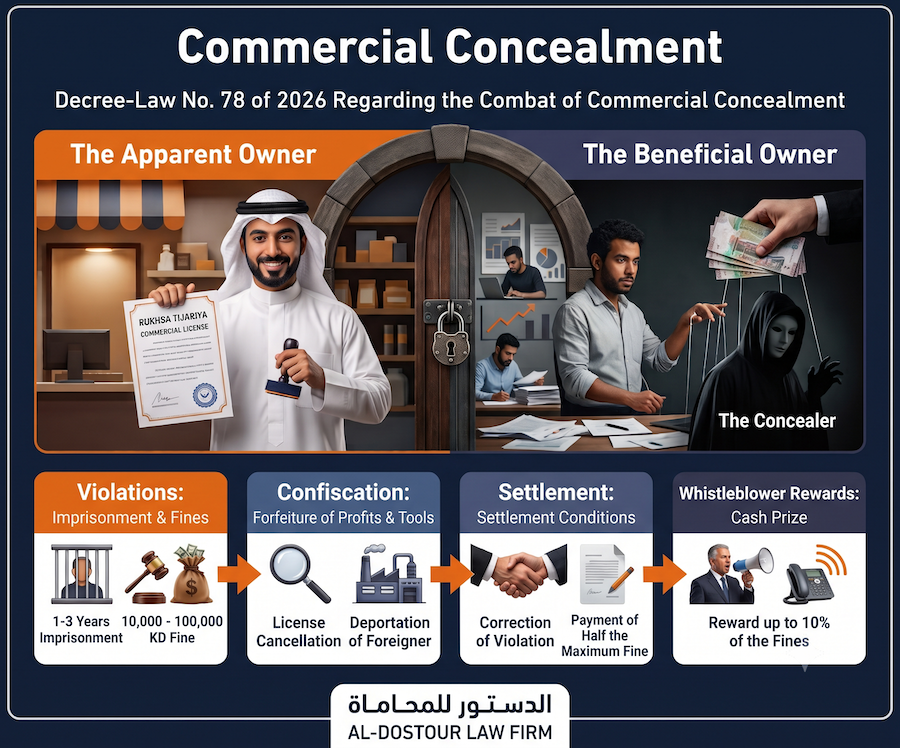
Quick answer: The new commercial concealment law in Kuwait — Decree-Law No. 78 of 2026, issued 2 August 2026 and gazetted 9 August 2026 — criminalises enabling any person to practise an economic activity prohibited to them, expressly including circumventing the foreign-ownership percentages set by Kuwaiti law. Penalties: 1–3 years' imprisonment and a fine of KD 10,000–100,000 or the equivalent of the profits obtained, whichever is greater, plus mandatory confiscation, permanent closure of the establishment, licence cancellation, deportation of the foreign violator, and publication of the judgment. A reconciliation route exists at no less than half the maximum fine, and whistleblowers can earn up to 10% of collected fines. The law takes effect six months after publication — around February 2027.
What is the commercial concealment law in Kuwait?
Article 1 of the commercial concealment law in Kuwait defines concealment (التستر التجاري) as enabling any person — natural or juristic — to practise an economic activity they are prohibited from practising under the laws in force, whether for their own account or in partnership, or circumventing the ownership percentages legally prescribed for foreigners to let them practise the activity in violation of the law. "Economic activity" is defined broadly: any commercial, investment, industrial, agricultural, service or professional activity aimed at profit and requiring a licence.
Article 2 then prohibits two mirrored acts: practising an economic activity without (or beyond) the required licence where the practice runs through a person who enables it; and enabling another person through concealment — expressly including allowing the use of one's trade name, licence, approval or commercial register, or any other means. Renting out a licence or register is, in itself, the crime.
Who does the commercial concealment law in Kuwait catch?
| Role | Practical example | Basis & liability |
|---|---|---|
| The concealed party | A person running a business prohibited to them under another's name, or exceeding permitted foreign-ownership limits | Article 2 — full Article 3 penalties |
| The front (enabler) | A licence or commercial-register holder letting someone else operate under it for a monthly fee | Article 2 — same penalties; the crime catches both sides |
| The actual manager | A manager who knew of the violation, or whose breach of duties caused or contributed to it | Article 5 — punished with the same prescribed penalties |
| The company itself | A juristic person in whose name or interest an employee committed the violation | Article 5 — jointly liable for fines and compensation |
Penalties: prison, profit-linked fines, mandatory confiscation, deportation
| Violation | Imprisonment | Fine | Mandatory additional measures |
|---|---|---|---|
| Commercial concealment (Art. 2) | 1 to 3 years | KD 10,000–100,000 or the equivalent of the profits obtained, whichever is greater — or either penalty | Confiscation of funds, profits, tools and equipment; permanent closure; licence cancellation; deportation of the foreign violator after serving the sentence; publication of the final judgment (Art. 6) |
| Obstructing officials or providing false/misleading information (Art. 11) | Up to 6 months | Up to KD 10,000 — or either penalty | — |
| Recidivism within 5 years of a final judgment | Penalty is doubled (Art. 7) | Reconciliation is barred | |
Fines multiply with each violating person and each violating activity — fronting three activities means three fines. Article 6 protects bona fide third parties: confiscation is limited to the crime's proceeds and instruments.
Reconciliation: a conditional exit before final judgment
Article 8 lets the competent Minister (or a delegate) settle concealment offences before the case is referred, during trial, or before final judgment, on strict terms:
- The price: payment of no less than half the maximum prescribed fine — i.e., at least KD 50,000 for the concealment offence.
- Removal of the violation and correction of the legal position — a precondition; no settlement while the illegal structure continues.
- The effect: the criminal case is extinguished.
- The limits: settlement does not prevent administrative deportation where the national interest requires it, and no settlement is available for repeat offenders.
Whistleblower rewards: up to 10% of collected fines
Article 9 introduces a financial incentive to report: a non-perpetrator informant who provides serious, reliable evidence on which a final conviction is based earns a reward — set by ministerial decision — of up to 10% of the collected fines, split equally among multiple informants. In practice this sharply raises exposure risk: employees, partners and competitors now have a direct financial interest in reporting concealment arrangements.
When does the commercial concealment law in Kuwait take effect?
Article 14 provides that the law enters into force six months after its publication in the Official Gazette. Published on 9 August 2026, it therefore takes effect around February 2027. Those six months are, practically, the only window to restructure existing arrangements — the law contains no amnesty programme or additional regularisation period.
What businesses and licence holders should do now
- Audit existing structures: examine any nominee arrangements, side agreements or powers of attorney through which activities are run for someone who lacks the licence or exceeds ownership limits.
- Fix foreign ownership lawfully: assess licensing under the Direct Investment Promotion Law No. 116 of 2013 (which permits up to 100% foreign ownership in defined activities) or restructuring under the Companies Law No. 1 of 2016 — see our Corporate & Commercial practice and our guide to company formation in Kuwait.
- Document actual management: align reality with the registers — whoever actually manages should legally appear, protecting managers from Article 5 liability.
- Review trade-name and register use agreements: any "licence rental" must be terminated or converted into a lawful, documented relationship (registered partnership, franchise, disclosed management contract).
- Prepare for inspections: Ministry of Commerce officials will hold judicial-police powers (Art. 10), and obstructing or misleading them is a standalone offence — keep documents and data ready.
Is your structure ready for the commercial concealment law in Kuwait?
Al-Dostour Law Firm reviews structures and licences, handles restructuring and foreign direct investment applications, and represents companies in reconciliation proceedings — in Arabic and English.
Call +965 2220 4084WhatsApp usThe full Arabic text appears in Kuwait Today (الكويت اليوم), Official Gazette issue No. 1803 of 9 August 2026, via the Ministry of Commerce and Industry.
Commercial Concealment in Kuwait — FAQ
What is commercial concealment in Kuwait?
Enabling any person to practise an economic activity prohibited to them, or circumventing the foreign-ownership percentages set by law, under Article 1 of Decree-Law 78/2026.
Is the licence holder who "rents out" the licence also punished?
Yes. The offence catches both the front and the concealed party; allowing use of one's trade name, licence or commercial register is expressly covered by Article 2.
What are the penalties?
One to three years' imprisonment and a fine of KD 10,000–100,000 or the equivalent of the profits obtained (whichever is greater), or either penalty — plus mandatory confiscation, permanent closure, licence cancellation, deportation of the foreign violator, and publication of the judgment.
Is reconciliation available?
Yes, before final judgment, against payment of no less than half the maximum fine, conditional on removing the violation and correcting the legal position. It is barred for repeat offenders.
Is there a whistleblower reward?
Yes — up to 10% of collected fines for non-perpetrator informants whose serious evidence leads to a final conviction.
When does the law take effect?
Six months after its publication in the Official Gazette on 9 August 2026 — around February 2027.